- Water - High Grade Resource, Low Grade Uses
-
Water is a necessity of life and far too many of us take it for granted. In reality, it requires a huge amount of energy and planning to pump, filter, treat and convey water from its various sources to its final use. For many facilities, a majority of water use can be attributed to irrigation and flushing toilet fixtures. These uses don't require the same level of treatment as drinkable water, so why do we expend all that energy and planning to treat water to this drinkable level only to (literally) flush it away?

Rainwater harvesting is a technique that has been around for thousands of years and there are many ways to accomplish this. Simple rain barrels are the most cost-effective way to collect and conserve rainwater for personal uses such as gardening or home and yard maintenance. For commercial applications, single and multi cell detention and reclaim systems are used, and are commonly referred to as cistern systems. This is for rainwater harvesting that requires water to not only be collected and stored, but also filtered and treated to meet applicable health codes.
These systems also require a mechanism to deliver water from the container to its end use. To accomplish this, a rainwater cistern can be connected to electric booster pumps that convey the water from the cistern storage tank to a building's flush fixtures or irrigation systems. In some instances, these systems can also be designed to detain, treat, and convey stormwater runoff during heavy rain events.

The volume of the cistern can vary widely depending on its expected performance and the size of facility it is supporting. A cistern can be designed to simply supplement potable (drinking) water use, or it can be designed to offset the entire water demand. To compliment rainwater harvesting, consider pairing with a low-flow fixture strategy. Low-flow fixtures can help reduce water use for waste conveyance by up to 40 percent, thus reducing the demand on cistern storage.
When you take into consideration occupancy loads and building use along with the local climate and its precipitation rate, a rainwater harvesting system can help to offset a majority - if not all of the remaining load. This is, of course, at the discretion of Mother Nature. Periods of low rain or dry spells will impact the amount of water available for use. But, by researching historical weather data, insufficient water periods can be planned for and cistern designs can be modified to accommodate specific climatic concerns.
In addition, systems can be tied to domestic water lines to ensure a cistern will never go dry - it will pump in additional water when the cistern falls below a pre-set level.
Thats a good decision for saving water in smalln houses and also it coulld be used in apartment however becouse of space limitation this amount water could be used for cleaning the street or lifts and e.t.c
Monday, 2 April 2012


sustainable practices through preserving collective memory

As distinct from history, archaeology deals with a long-gone past of which we have no personal memory. Archaeological open air museums aim to bring that distant past to life. Their stories are key, serving as a bridge between science and the public. Because they create memories, archaeological museums are responsible for transmitting an accurate message to visitors, to provide answers and raise questions such as ‘who would we like to have been?’ and ‘who do we want to be now and in the future?’ http://exarc.net/
Archaeological open air museums do not present collections of findings and artefacts. They present a pure interpretation of the past, ideally based on the latest research. Archaeological open air museums have a special relationship with memory. Although they sometimes offer a more creative and artistic interpretation of the past through collaborative projects, conferences and publications they are useful in linking the reality of the past with the present context. In addition, they can offer visitors an alternative view of the world and help them to find answers. The main challenge lies in helping visitors find new ways to explore a complex past and to ask questions that help them understand the present, thus generating ideas for the future.
In context of environmental care and societal development, museums can be seen as institutions that help to foster or develop awareness of the need to change people 's attitudes to the environment, in particular in terms of biodiversity, energy politics, and poor social conditions in some countries.
In my view, as memory and cultural heritage are key elements of wellbeing and the ability to maintain and reflect on traditions and identities in order to shape the future, preserving memory should be integrated into each vision of this planet. Today, we live in a world where entertainment dominates over education, and in order to provide the public with knowledge , open air archaeology museums find a good method to provide examples of alternative ways of thinking and living.
Sunday, 1 April 2012
The "new old" power sources.
An important factor of sustainable living is renewable energy. In general, the sustainable sources that we use now for getting energy haven't changed since ancient times. In the past, people have harnessed the power of the wind, water, earth and sun. But it was done in a much less efficient way than it is possible today. The inefficiency was the main reason for development and wide implementation of unsustainable power sources such as nuclear power plants, coal mines and petroleum.

 Windmill
 Root Cellar
Such sources of energy were dependent on the location of the source. So the energy of windmills and watermills could only be used at the source (could not be transferred). But with advent of new technologies, such as ball bearings and electric power generators, we can now harness those sources more efficiently and transfer energy at large distance.
I think the level of technological development allows us to make a better use of these "new old" energy sources in our design for sustainable living. Perhaps they still can't compete with modern high-output, high-power sources, but it would be a good step to take the strain off the environment overall. In future we should rely more and more on these clean, sustainable energy sources and put more effort in implementing the new sources, such as solar panels and thermal energy systems.

Watermill
 Windmill
 Root Cellar
Such sources of energy were dependent on the location of the source. So the energy of windmills and watermills could only be used at the source (could not be transferred). But with advent of new technologies, such as ball bearings and electric power generators, we can now harness those sources more efficiently and transfer energy at large distance.
I think the level of technological development allows us to make a better use of these "new old" energy sources in our design for sustainable living. Perhaps they still can't compete with modern high-output, high-power sources, but it would be a good step to take the strain off the environment overall. In future we should rely more and more on these clean, sustainable energy sources and put more effort in implementing the new sources, such as solar panels and thermal energy systems.




A Low Impact Woodland Home
I find this approach quite sustainable, moreover I’m thinking about my own house built this way. I and my husband actually take into consideration this kind of living in future. In Europe, particularly in Great Britain these kinds of houses are pretty normal way of life for people.
I really like the design of the house, its functionality and quite cheap price - the result a hand crafted home of beauty, warmth and health for about £3,000. I and do not see the reason not to follow such successful example.


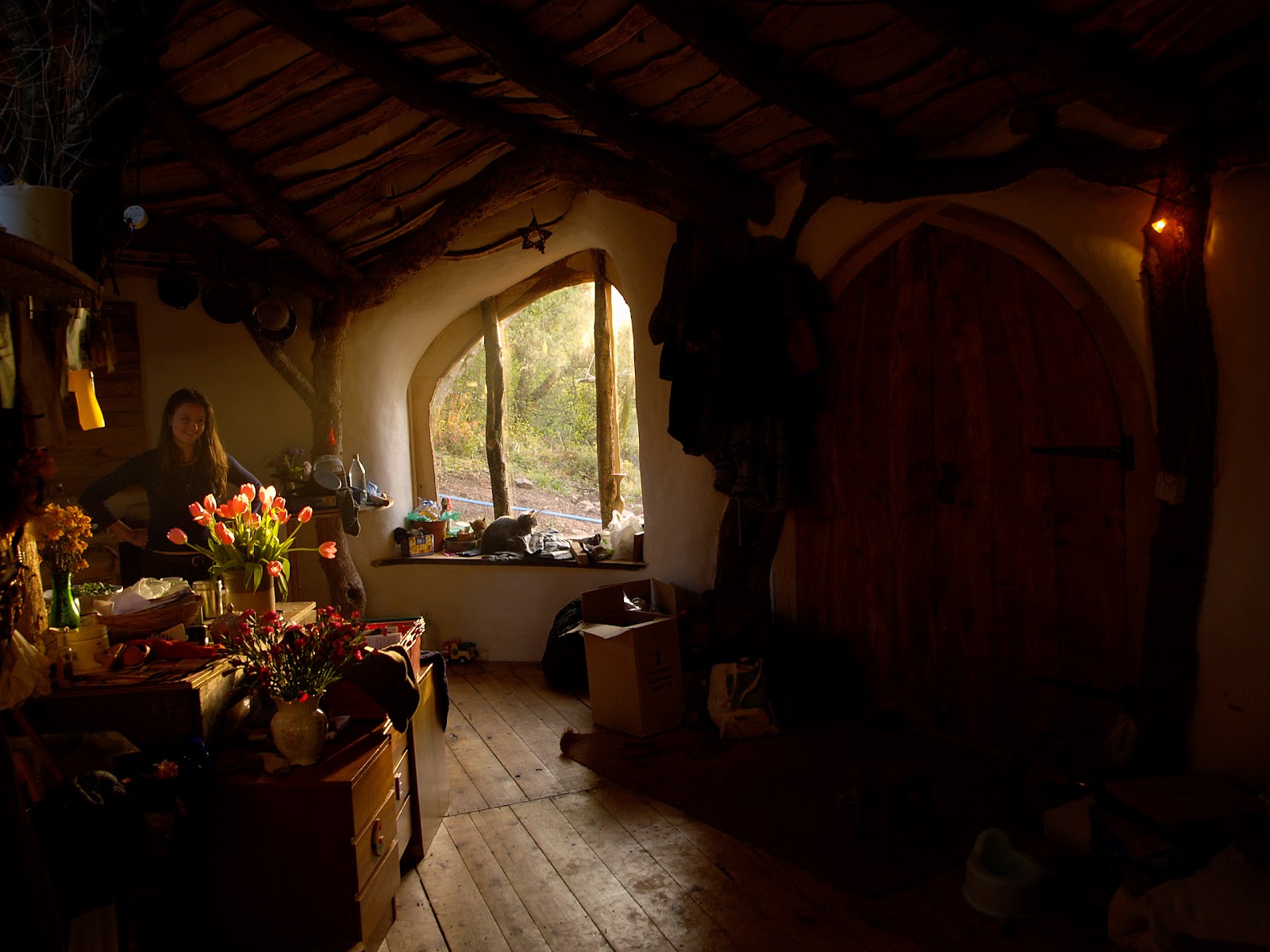


You are looking at pictures of a house Simon Dale built for his family in Wales. It was built himself and his father in law with help from passers by and visiting friends. 4 months after starting they were moved in and cosy. He estimates 1000-1500 man hours and £3000 put in to this point. Not really so much in house buying terms (roughly £60/sq m excluding labour).
The house was built with maximum regard for the environment and by reciprocation gives them a unique opportunity to live close to nature. Being your own (have a go) architect is a lot of fun and allows you to create and enjoy something which is part of yourself and the land rather than, at worst, a mass produced box designed for maximum profit and convenience of the construction industry. Building from natural materials does away with producers profits and the cocktail of carcinogenic poisons that fill most modern buildings.
Some key points of the design and construction:
-Dug into hillside for low visual impact and shelter
-Stone and mud from diggings used for retaining walls, foundations etc.
-Frame of oak thinnings (spare wood) from surrounding woodland
-Reciprocal roof rafters are structurally and aesthaetically fantastic and very easy to do
-Straw bales in floor, walls and roof for super-insulation and easy building
-Plastic sheet and mud/turf roof for low impact and ease
-Lime plaster on walls is breathable and low energy to manufacture (compared to cement)
-Reclaimed (scrap) wood for floors and fittings
-Anything you could possibly want is in a rubbish pile somewhere (windows, burner, plumbing, wiring...)
-Woodburner for heating - renewable and locally plentiful
-Flue goes through big stone/plaster lump to retain and slowly release heat
-Fridge is cooled by air coming underground through foundations
-Skylight in roof lets in natural feeling light
-Solar panels for lighting, music and computing
-Water by gravity from nearby spring
-Compost toilet
-Roof water collects in pond for garden etc.
Main tools used: chainsaw, hammer and 1 inch chisel, little else really. Oh and by the way Simon Dale is not a builder or carpenter, his experience is only having a go at one similar house 2yrs before and a bit of mucking around inbetween. This kind of building is accessible to anyone. His main relevant skills were being able bodied, having self belief and perseverence and a mate or two to give a lift now and again.
I am sure, this building is one part of a low-impact or permaculture approach to life. Simon says "This sort of life is about living in harmony with both the natural world and ourselves, doing things simply and using appropriate levels of technology. These sort of low cost, natural buildings have a place not only in their own sustainability, but also in their potential to provide affordable housing which allows people access to land and the opportunity to lead more simple, sustainable live".
I can imagine living myself in such kind of houses together with my family and I will be happy with it.
In the present days there is a growing popularity of the sustainable houses, produced commercially and there is a company Solaleya, which specializes on it. But I’m afraid the price will be much more than £3,000.
http://www.simondale.net/house
World's Most Polluted Cities
Hi, there!!!
North America.
The three most polluted cities on the North American continent are Pittsburgh in the USA, Windsor in Canada and Mexico City in Mexico.
Pittsburgh. The U.S.A.

Pittsburgh's skyline. By spike55151
Polluted air is a serious threat to 189 million United States' residents and six in ten Americans live in cities where the level of ozone or particle pollution is so high that it can lead to asthma, bronchitis, heart attack and even death. Pittsburgh, the second largest city in the state of Pennsylvania, is an example of one of the most polluted cities in the country.
It comes as a big surprise that over recent years Pittsburgh has many times been named "the most livable city in the USA". Still, according to the American Lung Association's annual report, the city has reported the highest short-term particle pollution (amount of tiny solid and liquid particles in the air such as soot or exhaust) and the second highest year-round levels. Main sources of such pollution are cars, coal-fired power plants and steel industry. Some researches claim, however, that the city's air pollution comes from the factories in Ohio.
Windsor. Canada.

Windsor. Ontario, Canada. By lepiaf.geo
Windsor, the major city of Southwestern Ontario, Canada, is the country's hub of the automobile industry. However, its main source of air pollution is the industry located in the U.S. The city is situated at the Canada-U.S. border, and therefore, around 90% of smog comes from the American side. By the way of example, there are four coal-fired power plants in Ontario, while U.S. Midwest is home to around 250 such plants.In 2008 Robert F. Kennedy Jr., an environmental activist, claimed that American companies made Windsor "the most polluted city in North America." According to Kennedy, the city reports some of the highest cancer rates and respiratory illnesses rates in Canada. In turn, the Weather Network has named Windsor "the smog capital of Canada", the channel underlines, however, that one of the main sources of poor air quality are vehicle emissions.
Mexico City. Mexico.

Rush hour in Mexico City. By Gary Denness
The capital of Mexico and one of the world's most populated cities is an ecological trap due to its geographical location. The city is situated in a valley, around 7,300 feet (2,240 meters) above sea level, so the air is really thin and the exhausts get trapped. Moreover, the winds in circulation are too weak to diffuse the contaminated air outside the metropolis.The recent research reveals that the smog hanging over the city is a serious threat to its residents, especially children. Apparently, Mexico's polluted air prevents lungs from growing and working properly. According to National Public Health Institute, the effect of exposure to contaminated air in Mexico City is bigger than the effect of exposure to maternal smoking among children in the U.S.To alleviate the problem of air pollution local and federal authorities have been implementing various plans, which include closing factories, " A day without a car" programs , modernizing old buses and promoting the use of bikes.
South America
La Oroya. Peru.

Mining in La Oroya. Peru. By Matthew Burpee
The town of about 33,000 residents, situated in the central part of Peru, is home to enormous smelting industry. The first copper smelter emerged in La Oroya in 1922 and since then many other plants and refineries followed. The town's heavy industry has transformed this little mountain village into one of the most polluted places on the globe. Among most serious pollutants found in La Oroya is lead, which is especially devastating to children's health. 99% of children living in the town have high degree of lead in their blood, which is especially harmful to kids' mental development.The Missouri-based Doe Run, which owns the smelting business in La Oroya, has been obliged to implement an environmental management plan that will reduce the emissions. In some areas the progress has been made as the company has managed to lower some emissions and has invested (jointly with the Peruvian Ministry of Health) $1 million yearly in the program designed to reduce blood lead levels in the area. The ecologists underline, however, that the sulfur dioxide emissions have remained very high in the town and lead will stay in the area's soil for centuries.
Europe
Pernik. Bulgaria.

Pernik in Bulgaria. By niv
Pernik, a town of about 90,000 inhabitants situated near Sofia, is considered to be the worst polluted place in the country and the entire European Union. In the mid-20th century the development of coal industry commenced in the region, transforming Pernik into the energy center of Bulgaria. Today the town is home to a large number of metallurgy plants that cause extreme pollution in the region. According to the recent report revealed by the EU, the average dust concentration in Pernik totals 92 microgrammes per cubic meter, which is the highest level among the EU member states, which report 30 mg of dust level on average.Apparently, Bulgaria itself is the most contaminated country among European Union states. It is filled with old cars with no catalytic converters and there are plenty second-hand vehicles from western European countries. Moreover, most of the country's small towns use coal-fired heating during winter, which is a great contributor to unhealthy emissions.
Chernobyl. Ukraine.

Abandoned amusement park in Chernobyl. By Pedro Moura Pinheiro
Chernobyl, a small town in northern Ukraine, near the border with Belarus, is associated with the Chernobyl accident - the worst nuclear power plant disaster in history. The accident occurred in April 1986 causing many deaths mainly due to the radiation poisoning. About 336,000 people living in some areas of Ukraine, Belarus and Russia had to be evacuated because of extreme contamination, and nuclear rain was observed in Central, Western, and as fas as Northern Europe.Today Chernobyl remains one of the most polluted places on Earth. There is a 19-mile (30 km) exclusion zone around the town where people are not allowed to live. Still, between 1992 and 2002 around 4,000 of thyroid cancer cases were found among children living near the zone.
According to various estimates between 60 and 200 years is needed before the land could be used for some industrial purposes, and farming would be very dangerous for at least 200 years. The place where Reactor #4 exploded is estimated to be fully safe in 20,000 years.
Asia
Norilsk. Russia. (Still can't believe I was born there)

Smelting industry in Norilsk, Russia. By Lvovsky
Norilsk, the second largest city above the Arctic Circle, inhabited by about 130,000 people, is the mining and smelting industry hub of Russia. The first plants appeared in the town in the 1930s and today Norilsk is home to the world's largest smelting complex. The town of acid rain and smog is the country's greatest polluter - it releases 500 tones of each copper and nickel oxides and 2 million tons of sulfur dioxide annually.
The main culprit for this situation is Norilsk Nickel, a huge firm that controls one-third of the world's nickel deposits and is Russia's main producer of nickel, cobalt, platinum and palladium.Such heavily contaminated air causes serious health problems such as respiratory diseases, higher mortality, pregnancy complications and lung cancer. According to the Blacksmith Institute, an organization supporting pollution-related environmental projects, "children living near the nickel plant were shown to become ill at a rate 1.5 times higher than children from further districts."Linfen.
The main culprit for this situation is Norilsk Nickel, a huge firm that controls one-third of the world's nickel deposits and is Russia's main producer of nickel, cobalt, platinum and palladium.Such heavily contaminated air causes serious health problems such as respiratory diseases, higher mortality, pregnancy complications and lung cancer. According to the Blacksmith Institute, an organization supporting pollution-related environmental projects, "children living near the nickel plant were shown to become ill at a rate 1.5 times higher than children from further districts."Linfen.
China.

Fields in front of a new factory emerging in Linfen. By sheilaz413
Smog covers the city of Linfen that sits along the banks of the Fen River in China. In 2007 the city, home to around 4 million people, was considered by the Blacksmith Institute the world's most polluted town. Linfen is home to an enormous coal industry, filled with hundreds of legal and illegal mines, steel plants and refineries, providing almost two thirds of China's energy. The air is dark in the town and its inhabitants literally choke on coal dust. The level of sulfur dioxide and other particulates exceeds any acceptable limits and there is a shortage of water due to contamination of drinking water sources by arsenic.The Linfen's residents suffer from various diseases such as lung cancer, bronchitis, pneumonia, and the children's blood lead level is many times higher than any acceptable norms.According to the World Bank, 16 out of 20 of the world's most polluted cities in terms of air quality are in China.
Africa
Kabwe. Zambia

Abadoned industrial site near Kabwe, Zambia. By Les Amis de la Terre
Kabwe, home to 210,000 residents, is the capital of Zambian Central Province, Zambia. In 1902 lead and zinc deposits were found in the town and soon after the smelting and mining industry were set up and operated until 1994. The plants were closed down but they left the city's soil and water polluted by lead and metals. Children's blood lead levels are up to 10 times higher than the acceptable limits set by the U.S. Environmental Protection Agency.Since 2007 some serious actions have been undertaken to clean up the most contaminated areas of Kabwe. By the way of example, the World Bank allocated $40m for a clean-up program and the Nordic Development Fund granted $10m to the region. In fact, many areas of the town still need to be relocated.
Subscribe to:
Posts (Atom)